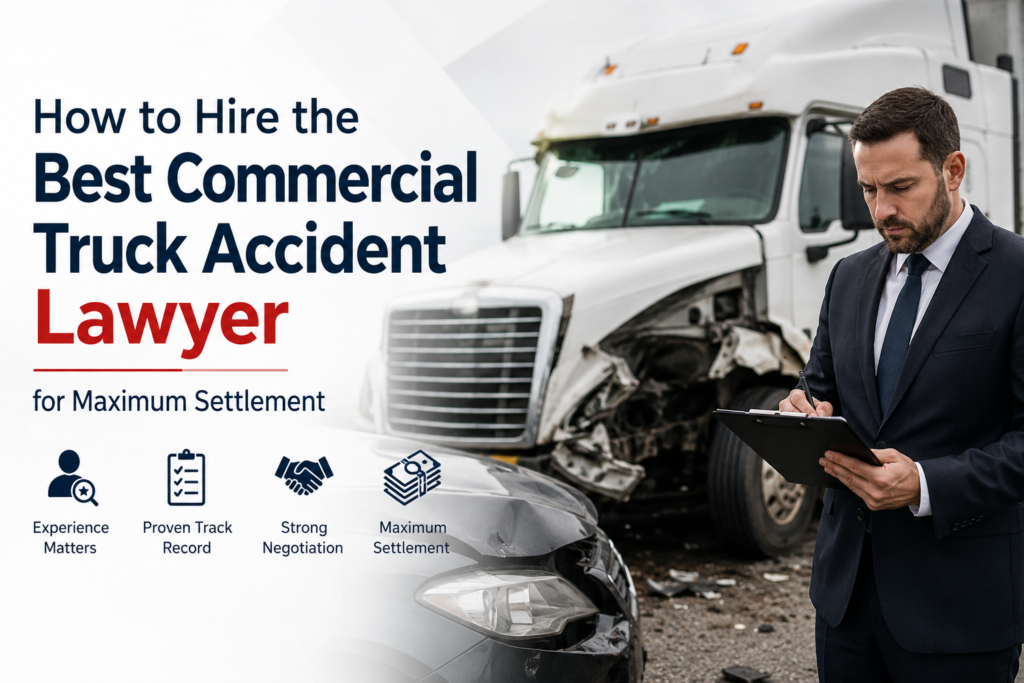

How How to Hire the Best Commercial Truck Accident Lawyer for Maximum Settlement
Commercial truck accidents involve severe bodily injuries, substantial property damage, and multi-million-dollar insurance policies. Because semi-trucks, 18-wheelers, and tractor-trailers can weigh up to 80,000 pounds, collisions with passenger vehicles frequently lead to catastrophic life-altering injuries or wrongful death.
If you or a family member was involved in an accident with a commercial vehicle, securing full compensation requires partnering with a specialized commercial truck accident lawyer. Unlike standard auto collisions, trucking litigation involves complex federal regulations, multiple corporate defendants, and aggressive corporate legal defense teams.
Why Commercial Trucking Accidents Are Legally Complex
Navigating a commercial motor vehicle claim requires a legal team with specialized expertise in transportation law and federal safety mandates.
Commercial trucking claims differ from everyday vehicle accidents in four major ways:
- Federal Regulations (FMCSA Standards): Commercial drivers and motor carriers are governed by the Federal Motor Carrier Safety Administration (FMCSA). Regulations mandate strict rules regarding Hours of Service (HOS), mandatory driver rest periods, vehicle maintenance logs, and alcohol/drug testing.
- Multiple Potentially Liable Parties: A single collision may involve the truck driver, the trucking company, the cargo loading facility, maintenance contractors, vehicle equipment manufacturers, and third-party logistics brokers.
- Aggressive Rapid-Response Teams: Major commercial trucking insurers deploy immediate response teams—including private investigators and defense attorneys—to the crash scene within hours to mitigate corporate liability and preserve evidence favorable to their defense.
- Substantial Insurance Policy Limits: Commercial fleets routinely carry liability insurance policies ranging from $750,000 to over $5,000,000. Higher financial coverage prompts insurance carriers to aggressively contest liability and damages.
Key Qualities to Look for in a Top Truck Accident Attorney
To level the playing field against corporate legal teams, you must choose an attorney who specializes specifically in heavy vehicle collisions.
| Evaluation Criteria | What You Need to Verify | Why It Is Vital |
|---|---|---|
| Proven Trial Verdict Record | History of multi-million-dollar jury verdicts and settlements | Shows insurers your legal team is ready to take the case to trial |
| Investigative Resources | Access to accident reconstructionists & black box technicians | Essential for extracting digital data and proving vehicle fault |
| Contingency Fee Structure | $0 upfront retainer or out-of-pocket costs | Guarantees the law firm only gets paid if they recover compensation |
| FMCSA Legal Knowledge | Deep understanding of federal trucking compliance codes | Allows attorneys to identify regulatory violations that establish liability |
Crucial Electronic & Physical Evidence Your Lawyer Must Secure
In commercial trucking cases, critical evidence can be lost or overwritten within days or weeks following an accident. A dedicated attorney will immediately issue a formal Spoliation Letter to prevent the destruction of vital records.
Key evidence that must be secured includes:
- Electronic Logging Device (ELD) Data: Records continuous driving hours to verify if driver fatigue or FMCSA Hours-of-Service violations occurred.
- Engine Control Module (ECM / “Black Box”): Captures real-time telemetry prior to impact, including vehicle speed, braking response, throttle position, and seatbelt usage.
- Driver Qualification File (DQF): Contains the driver’s background checks, medical certification cards, past driving infractions, and employment screening results.
- Maintenance & Inspection Logs: Proves whether the commercial fleet neglected required brake checks, tire replacements, or mechanical repairs.
- Bills of Lading & Freight Records: Shows whether the truck was overloaded beyond federal weight thresholds or improperly balanced.
Types of Financial Compensation in Truck Accident Claims
A severe truck crash can impact every area of your personal, professional, and financial life. An experienced commercial attorney will calculate both immediate expenses and long-term financial impacts to demand full recovery:
- Current & Future Medical Expenses: Covers emergency care, surgeries, intensive care units (ICU), physical therapy, prescription medication, home modifications, and lifelong specialized care.
- Lost Income & Loss of Earning Capacity: Reimburses lost wages during recovery and accounts for future income loss if permanent disability prevents returning to work.
- Pain & Suffering: Compensates for physical pain, emotional trauma, post-traumatic stress disorder (PTSD), anxiety, and reduced quality of life.
- Wrongful Death Damages: In fatal crashes, surviving family members can claim funeral costs, loss of financial support, loss of companionship, and consortium.
- Punitive Damages: Awarded by courts in cases involving extreme corporate recklessness, such as forcing drivers to bypass safety limits or operating vehicles with known brake failures.
Essential Questions to Ask During Your Initial Legal Consultation
Before executing a representation agreement with a law firm, conduct a thorough interview during your initial consultation:
- How many commercial truck accident claims have you personally handled in the past 12 months?
- Will your lead trial attorneys handle my case directly, or will it be passed to junior associates?
- Do you have the financial capital to fund expert witnesses, accident reconstructionists, and medical specialists?
- How quickly will your team issue spoliation letters to preserve the truck’s electronic telemetry data?
- What are all potential legal costs or litigation fees if we win or settle out of court?
Understanding the Truck Accident Legal Timeline
Building a winning case against a commercial transportation company requires systematic legal preparation across distinct stages:
- Emergency Scene Investigation: Investigators visit the crash site, examine tire marks, document road conditions, and photograph property damage.
- Medical Treatment & Maximum Medical Improvement (MMI): Your legal team tracks medical progress until physicians provide a clear long-term prognosis.
- Comprehensive Demand Package: Your lawyer compiles all medical records, economic loss projections, and liability proof into a formal demand sent to the insurer.
- Negotiation & Mediation: Parties attempt to settle the claim for fair value. If the insurer offers an inadequate settlement, formal litigation begins.
- Trial Filing & Discovery: Both legal teams exchange evidence, take sworn depositions, and present arguments before a jury for a final verdict.
Act Swiftly: Strict Legal Timelines Apply
Every jurisdiction enforces a Statute of Limitations that restricts how long victims have to file a personal injury or wrongful death lawsuit following a commercial vehicle collision. Most state deadlines range between 1 to 3 years from the date of the crash.
Furthermore, key electronic evidence like black box data can be lawfully overwritten by trucking companies within 30 days if a legal spoliation notice is not issued immediately. Seeking immediate legal representation protects your right to full financial recovery. Hire the Best Commercial Truck Accident Lawyer for Maximum Settlement
Commercial truck accidents involve severe bodily injuries, substantial property damage, and multi-million-dollar insurance policies. Because semi-trucks, 18-wheelers, and tractor-trailers can weigh up to 80,000 pounds, collisions with passenger vehicles frequently lead to catastrophic life-altering injuries or wrongful death.
If you or a family member was involved in an accident with a commercial vehicle, securing full compensation requires partnering with a specialized commercial truck accident lawyer. Unlike standard auto collisions, trucking litigation involves complex federal regulations, multiple corporate defendants, and aggressive corporate legal defense teams.
Why Commercial Trucking Accidents Are Legally Complex
Navigating a commercial motor vehicle claim requires a legal team with specialized expertise in transportation law and federal safety mandates.
Commercial trucking claims differ from everyday vehicle accidents in four major ways:
- Federal Regulations (FMCSA Standards): Commercial drivers and motor carriers are governed by the Federal Motor Carrier Safety Administration (FMCSA). Regulations mandate strict rules regarding Hours of Service (HOS), mandatory driver rest periods, vehicle maintenance logs, and alcohol/drug testing.
- Multiple Potentially Liable Parties: A single collision may involve the truck driver, the trucking company, the cargo loading facility, maintenance contractors, vehicle equipment manufacturers, and third-party logistics brokers.
- Aggressive Rapid-Response Teams: Major commercial trucking insurers deploy immediate response teams—including private investigators and defense attorneys—to the crash scene within hours to mitigate corporate liability and preserve evidence favorable to their defense.
- Substantial Insurance Policy Limits: Commercial fleets routinely carry liability insurance policies ranging from $750,000 to over $5,000,000. Higher financial coverage prompts insurance carriers to aggressively contest liability and damages.
Key Qualities to Look for in a Top Truck Accident Attorney
To level the playing field against corporate legal teams, you must choose an attorney who specializes specifically in heavy vehicle collisions.
| Evaluation Criteria | What You Need to Verify | Why It Is Vital |
|---|---|---|
| Proven Trial Verdict Record | History of multi-million-dollar jury verdicts and settlements | Shows insurers your legal team is ready to take the case to trial |
| Investigative Resources | Access to accident reconstructionists & black box technicians | Essential for extracting digital data and proving vehicle fault |
| Contingency Fee Structure | $0 upfront retainer or out-of-pocket costs | Guarantees the law firm only gets paid if they recover compensation |
| FMCSA Legal Knowledge | Deep understanding of federal trucking compliance codes | Allows attorneys to identify regulatory violations that establish liability |
Crucial Electronic & Physical Evidence Your Lawyer Must Secure
In commercial trucking cases, critical evidence can be lost or overwritten within days or weeks following an accident. A dedicated attorney will immediately issue a formal Spoliation Letter to prevent the destruction of vital records.
Key evidence that must be secured includes:
- Electronic Logging Device (ELD) Data: Records continuous driving hours to verify if driver fatigue or FMCSA Hours-of-Service violations occurred.
- Engine Control Module (ECM / “Black Box”): Captures real-time telemetry prior to impact, including vehicle speed, braking response, throttle position, and seatbelt usage.
- Driver Qualification File (DQF): Contains the driver’s background checks, medical certification cards, past driving infractions, and employment screening results.
- Maintenance & Inspection Logs: Proves whether the commercial fleet neglected required brake checks, tire replacements, or mechanical repairs.
- Bills of Lading & Freight Records: Shows whether the truck was overloaded beyond federal weight thresholds or improperly balanced.
Types of Financial Compensation in Truck Accident Claims
A severe truck crash can impact every area of your personal, professional, and financial life. An experienced commercial attorney will calculate both immediate expenses and long-term financial impacts to demand full recovery:
- Current & Future Medical Expenses: Covers emergency care, surgeries, intensive care units (ICU), physical therapy, prescription medication, home modifications, and lifelong specialized care.
- Lost Income & Loss of Earning Capacity: Reimburses lost wages during recovery and accounts for future income loss if permanent disability prevents returning to work.
- Pain & Suffering: Compensates for physical pain, emotional trauma, post-traumatic stress disorder (PTSD), anxiety, and reduced quality of life.
- Wrongful Death Damages: In fatal crashes, surviving family members can claim funeral costs, loss of financial support, loss of companionship, and consortium.
- Punitive Damages: Awarded by courts in cases involving extreme corporate recklessness, such as forcing drivers to bypass safety limits or operating vehicles with known brake failures.
Essential Questions to Ask During Your Initial Legal Consultation
Before executing a representation agreement with a law firm, conduct a thorough interview during your initial consultation:
- How many commercial truck accident claims have you personally handled in the past 12 months?
- Will your lead trial attorneys handle my case directly, or will it be passed to junior associates?
- Do you have the financial capital to fund expert witnesses, accident reconstructionists, and medical specialists?
- How quickly will your team issue spoliation letters to preserve the truck’s electronic telemetry data?
- What are all potential legal costs or litigation fees if we win or settle out of court?
Understanding the Truck Accident Legal Timeline
Building a winning case against a commercial transportation company requires systematic legal preparation across distinct stages:
- Emergency Scene Investigation: Investigators visit the crash site, examine tire marks, document road conditions, and photograph property damage.
- Medical Treatment & Maximum Medical Improvement (MMI): Your legal team tracks medical progress until physicians provide a clear long-term prognosis.
- Comprehensive Demand Package: Your lawyer compiles all medical records, economic loss projections, and liability proof into a formal demand sent to the insurer.
- Negotiation & Mediation: Parties attempt to settle the claim for fair value. If the insurer offers an inadequate settlement, formal litigation begins.
- Trial Filing & Discovery: Both legal teams exchange evidence, take sworn depositions, and present arguments before a jury for a final verdict.
Act Swiftly: Strict Legal Timelines Apply
Every jurisdiction enforces a Statute of Limitations that restricts how long victims have to file a personal injury or wrongful death lawsuit following a commercial vehicle collision. Most state deadlines range between 1 to 3 years from the date of the crash.
Furthermore, key electronic evidence like black box data can be lawfully overwritten by trucking companies within 30 days if a legal spoliation notice is not issued immediately. Seeking immediate legal representation protects your right to full financial recovery.



Pingback: What Happens Next If There Is a Lindsay Clancy Trial Hung Jury? - Trend